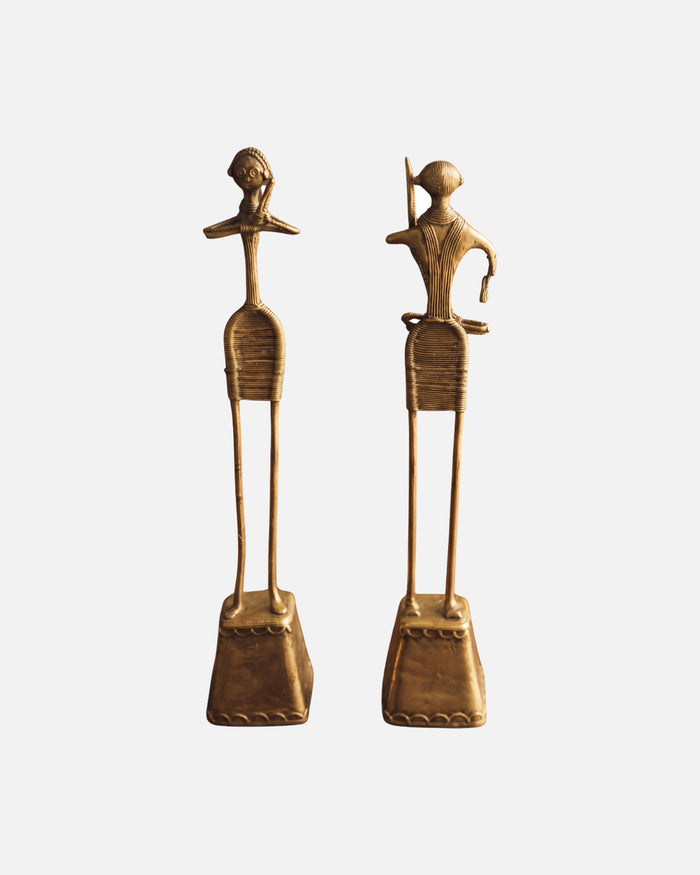
Dhokra Couple
$195.00

Bankura and Bardhaman, West Bengal, India
Please note: this video is AI-generated, used to illustrate the making process until we can film it directly. Real footage coming soon.
Brass poured into a clay mould that is broken open to free it, so every mould is used once. A way of casting metal traced back more than 4,000 years.
In Bengal, Dhokra lives in a few villages on the red earth at the edge of the Chota Nagpur plateau, most of all Bikna, near Bankura, and Dariyapur, in Purba Bardhaman. The materials come from close by: riverbed clay, rice husk, beeswax and dhuna, a resin from the forest trees. Even the metal is found nearby, as much of the brass is melted down from old utensils. In 2018, “Dokra of West Bengal” was registered as a Geographical Indication, applied for by the makers’ own societies in Bikna and Dariyapur.
A rough core is shaped from clay and rice husk. Beeswax is warmed with resin and pressed through a small wooden press into threads barely a millimetre thick, then coiled over the core, line by line, until every rib, spiral and band of the finished piece is laid in wax. The model is sealed under finer clay, leaving one small opening, and dried in the sun. In the kiln, the wax melts and runs out, and molten brass is poured into the hollow it leaves. Once cool, the clay is broken away, and the piece inside is seen for the first time.
The craft takes its name from the Dhokra Damar, metalsmiths who once moved from village to village, trading their castings for grain and oil. Over time they settled in Bengal, and in 1970 families were given land at Bikna to work together. More than 150 artisans cast there today, many of them Karmakars, and the makers of Dariyapur run their own cooperative. The skill passes from parents to children, and a single piece moves through three to five pairs of hands.
The bronze Dancing Girl of Mohenjo-daro, from the Indus Valley, was cast the same way. In Bengal, Dhokra makers cast lamps, caskets, measuring bowls and anklets, and figures for household shrines, including Lakshmi for newly married couples, believed to bring a home its prosperity. Horses stood for movement, elephants for strength and owls for good fortune.
Every line is a thread of wax laid by hand, and one piece takes seven to fifteen days. The moulds dry in open sun, so work slows through the monsoon, and a pour that is a little too hot or too cool can crack a mould and lose the work inside it.

