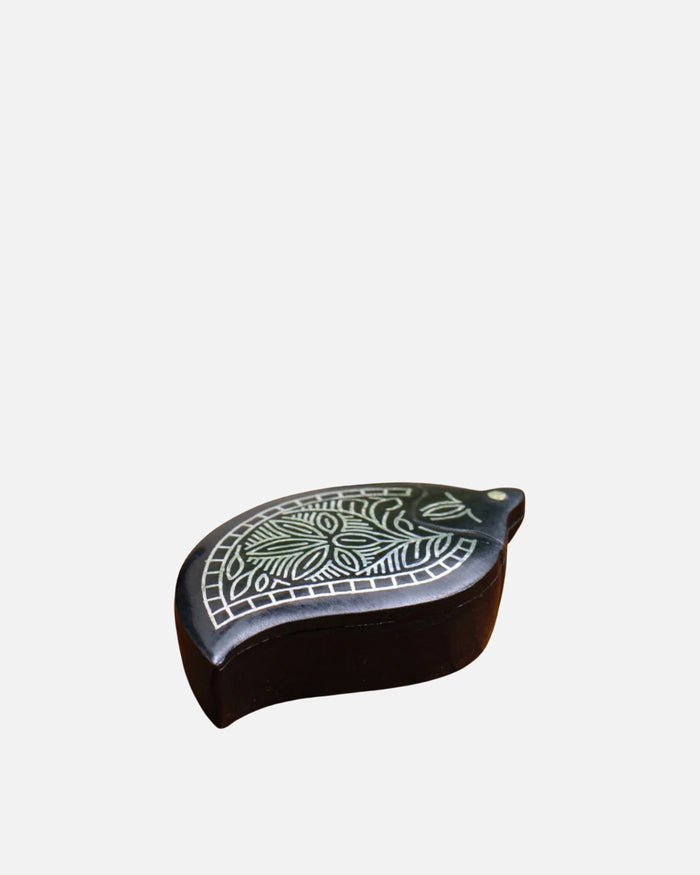
Bidri Paisley Box
$125.00

Bidar, Karnataka, India
Please note: this video is AI-generated, used to illustrate the making process until we can film it directly. Real footage coming soon.
Pure silver laid into metal, then turned black with earth from an old fort. The craft began at a Sultan’s court nearly 600 years ago.
Bidar sits on a red laterite plateau in the far north of Karnataka, below the walls of a fort the Bahmani Sultans made their capital in the 1400s. The craft takes its colour from that fort: its soil, rich in potassium nitrate, is the one ingredient makers say nothing else can replace. Bidriware was registered as a Geographical Indication in 2006, which protects the name for work made in this region.
Zinc is melted with a little copper, about sixteen parts to one, and poured into a mould. The cast is filed smooth and briefly darkened with copper sulphate, so the design can be drawn clearly on its surface. With a fine chisel and hammer, the engraver cuts a groove along every line, and pure silver is hammered into each one: as fine wire, called tarkashi, or as thin sheet set flush, called tehnishan. Last, the piece is warmed and rubbed with a paste of the fort’s soil, sal ammoniac and water. The metal turns a deep, matte black, the silver stays bright, and a final rub of oil deepens the black.
In Bidar, the craft is still carried by families, learned at a father’s or grandfather’s bench. One master has worked at it for 52 years. Some still test the fort soil by tasting it before they use it, to know whether it will give the right black.
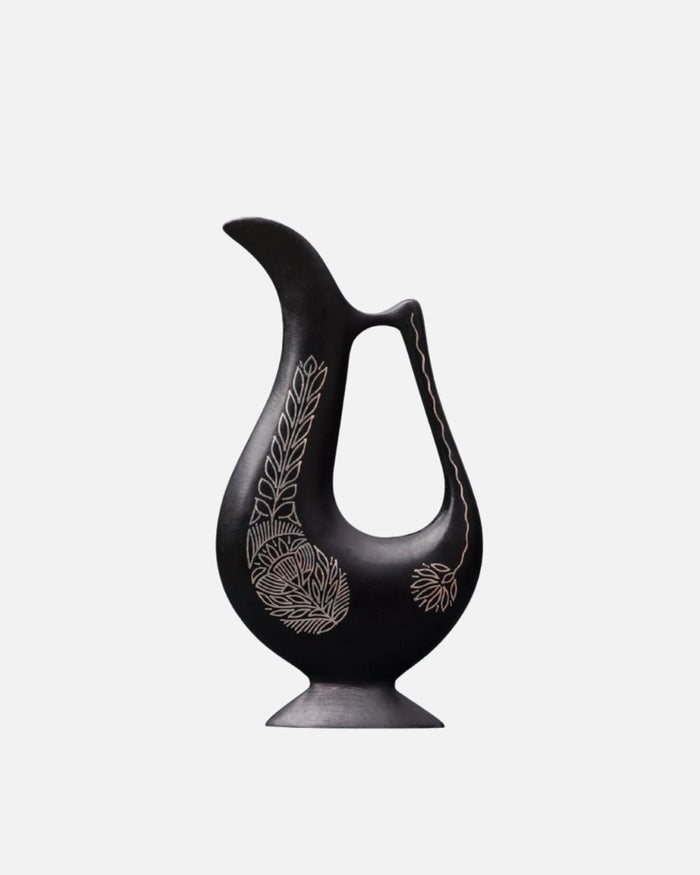
In the 15th century, Sultan Ahmad Shah Bahmani invited the Persian craftsman Abdullah bin Kaiser to decorate his palaces, and he worked alongside local metalsmiths. What they made together joined Persian pattern to Deccan metal. The court used it for hookah bases, paan boxes and vases, and the Persian rose is still one of its best-loved designs.
A single piece passes through eight stages, and every line of silver is set by hand. The black can only come from one fort’s soil, and today about 150 to 160 artisans in Bidar still practise the craft.
$125.00
$125.00