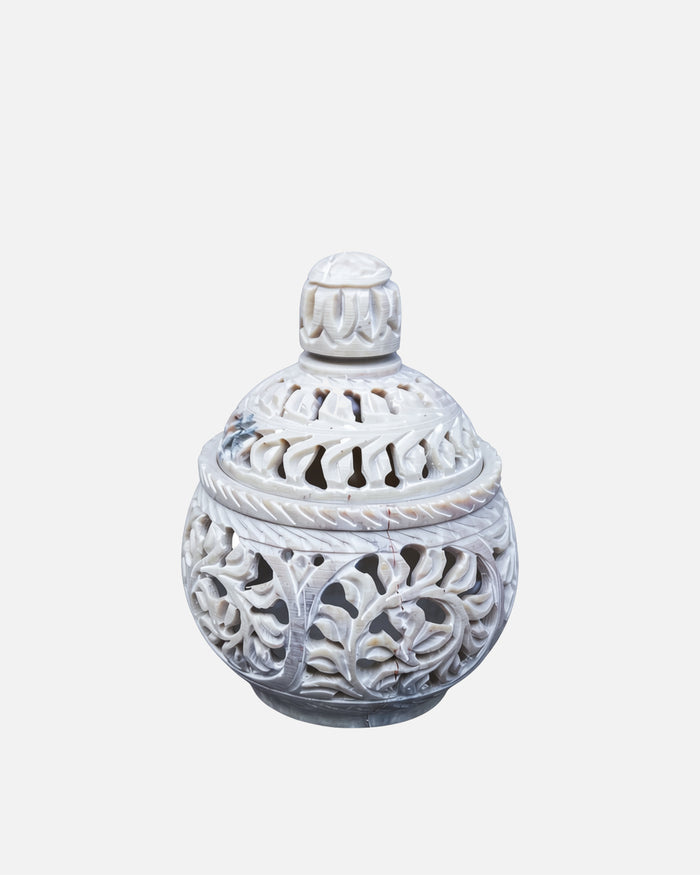
Soapstone Keepers
$125.00

Agra, Uttar Pradesh, India
Please note: this video is AI-generated, used to illustrate the making process until we can film it directly. Real footage coming soon.
Solid stone, carved by hand until it breathes. A lattice born in the screens of Mughal Agra, in a material India has worked for about 4,500 years.
In Agra, the city of the Taj Mahal, a few families still carve stone for a living, the way their ancestors once carved for the Mughal court. Their soapstone comes from the quarries of Jhansi, further south in Uttar Pradesh, and from Jaipur in Rajasthan. Each block is judged for softness and for hidden cracks, because only the cleanest stone can hold the finest lattice.
Soapstone is soft enough to be worked with the tools of a woodcarver, which is why it can hold such fine detail. The carver draws the pattern straight onto the stone in pencil, then opens it from within, drilling small holes and widening each one with chisels and slender needle files until the lattice appears. The most skilled carvers go further and undercut, reaching through the openings to shape a second form inside the first. It's called filigree for its thread-like lines, from the Latin filum, meaning thread.
The carvers of Agra trace their lineage to the Persian stone workers who came to the city under Shah Jahan, and they describe their work as a meeting of Islamic and Indian art. The skill has stayed within these families for generations, learned at home by watching and doing.
India has carved soapstone for about 4,500 years, since the Indus Valley, where it was shaped into seals and beads. The jali, from the Hindi and Urdu word for net, came much later, with the Mughals. In Shah Jahan's Agra, carvers cut screens of sandstone and marble that let breeze and light into a room while keeping it cool and private, and filled them with the vines and flowers that became the signature of the age. Under British rule, demand for the great screens faded. Over time, the carvers turned to softer soapstone, and the lattice moved from palace walls into the home.
A lattice can't be corrected. Every cut takes stone away for good, and too much pressure in a single opening can crack the whole piece. A fine lattice takes from two days to two weeks to carve, and today only a handful of families in Agra still carve the finest jali.

