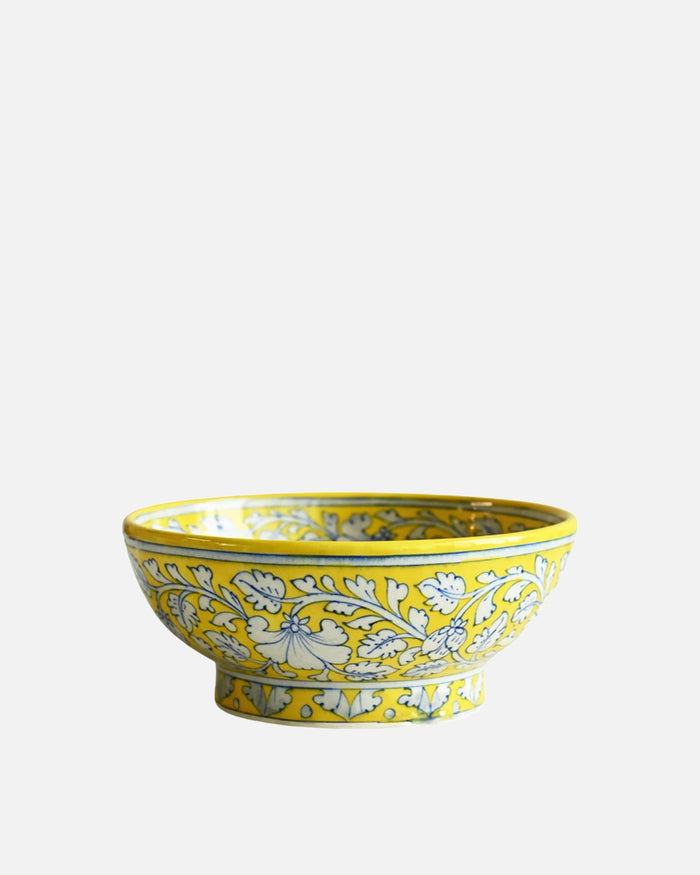
Jaipur Blue Bowl
$175.00

Jaipur, Rajasthan, India
Please note: this video is AI-generated, used to illustrate the making process until we can film it directly. Real footage coming soon.
Pottery made without clay: crushed quartz, powdered glass and fuller’s earth, painted freehand in cobalt blue. A Turko-Persian art made in Jaipur since the 1800s.
Jaipur’s blue pottery begins with stone. Quartz is ground to powder and mixed with powdered glass, fuller’s earth, borax and gum, and it is the quartz that keeps each piece light and lets its white glow faintly at the edges. The craft is made in Jaipur and in villages around it, such as Kot Jewar, and Blue Pottery of Jaipur was registered as a Geographical Indication in 2008.
With no clay to hold it, the dough can’t be thrown on a wheel. It is rolled out by hand and pressed into plaster moulds dusted with wood ash, then dried in the sun, sanded smooth and coated in a white slip. The pattern is painted freehand with fine squirrel-hair brushes, cobalt for blue and copper for turquoise, and the piece is glazed and fired at a low heat. One piece takes five to twelve days and two to four makers.
The craft lives in Jaipur’s family workshops, where moulding, painting and glazing are often done by different hands. By the mid-20th century it had nearly faded, and the painter Kripal Singh Shekhawat brought it back, with the support of Rajmata Gayatri Devi and Kamaladevi Chattopadhyay. He widened its palette with new colours, and his Jaipur studio, Kripal Kumbh, carries his name.
The craft is Turko-Persian in origin, reached India with the Turkic rulers of the 14th century and grew under Mughal patronage in Delhi. In the 1800s, the story goes, Maharaja Sawai Ram Singh II watched Delhi kite-flyers cut down his own with glass-coated strings. Curious about their glass craft, he sent two Jaipur potters, Churamani and Kalu Ram, to Delhi to learn it, and set up workshops for them at home. Its first work was for palaces: tiles, fountain basins, urns and water decanters.
Until it is fired, the clayless body is as fragile as packed sand, so every stage from mould to kiln is slow, careful handwork. Every pattern is painted freehand, one brushstroke at a time.

