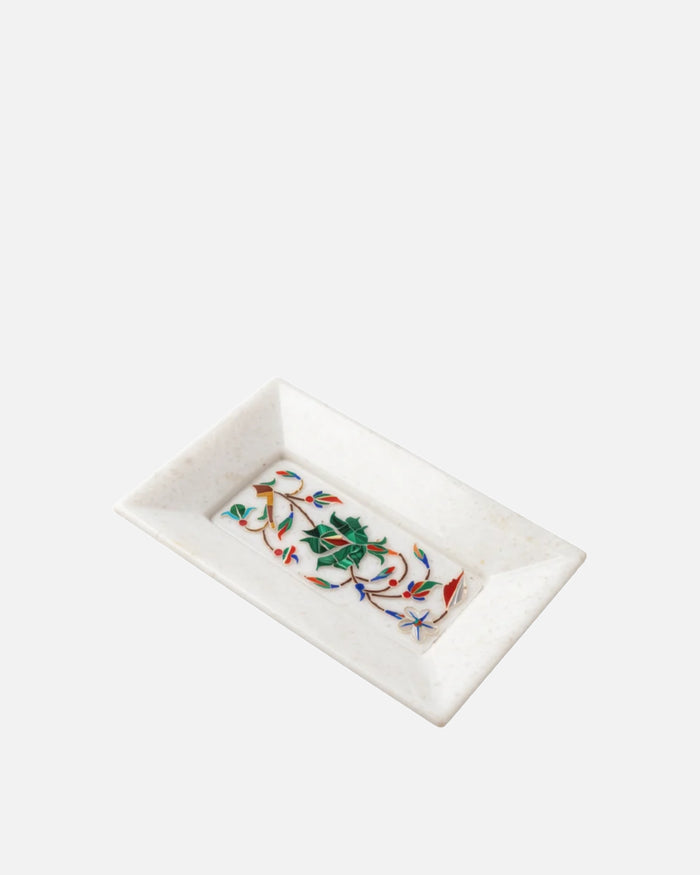
Marble Tray
$125.00

Agra, Uttar Pradesh, India.
Please note: this video is AI-generated, used to illustrate the making process until we can film it directly. Real footage coming soon.
Gemstones set into white marble so closely that the seams disappear. The art that flowered on the Taj Mahal, practised in Agra for about 400 years.
Marble inlay lives in Agra, in the old quarter of Tajganj that grew up beside the Taj Mahal, where more than a thousand artisans still work. The marble comes from Makrana in Rajasthan, the same quarries that gave the Taj its white. The coloured stones are chosen one by one: lapis for blue, malachite for green, carnelian for red and mother-of-pearl for light. Since 2025, Agra Stone Inlay Work has carried a GI tag, protecting the name for inlay made in the city.
The design is drawn onto the marble first, and each stone is then shaped by hand on a saan, a small grinding wheel, until it matches its place in the pattern exactly. A shallow groove is carved into the marble to receive it, and the pieces are set in one at a time. Finally, the whole surface is polished until marble and stone lie perfectly flush, so smooth that a fingertip can't find the join.
Most of Agra's inlay artisans trace their families back to the craftsmen who decorated the Taj Mahal, and the skill is still passed down at home. A single piece can pass through several pairs of hands: one draws the design, another cuts the stones, and another sets them into the marble.
Stone set into stone has a long lineage, from ancient Rome to Renaissance Florence, where it was called pietra dura, hard stone. It reached Mughal India in the 16th century. In Agra, Empress Nur Jahan built a tomb for her father, Itmad-ud-Daula, the first Mughal building made entirely of white marble, inlaid with mother-of-pearl, jasper and carnelian. A decade later, her stepson Shah Jahan carried the art to its height in the Taj Mahal, with stones brought from as far as Afghanistan, Turkey and China.
Every stone is shaped by hand for one place in one pattern, so no piece can be hurried. A single piece can pass through the hands of four to eight makers and take days, weeks or even months. Machine-made copies now fill Agra's markets, which makes true hand-set inlay, every stone cut to its place, harder to find.

